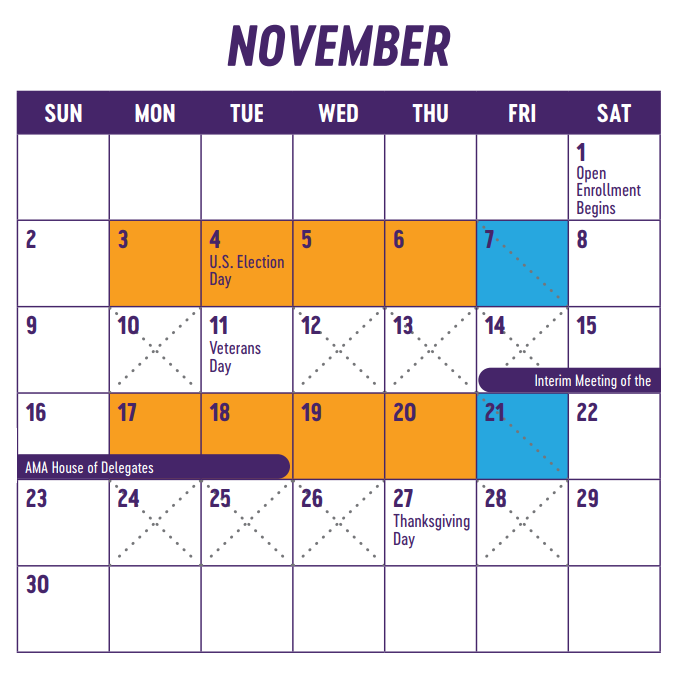
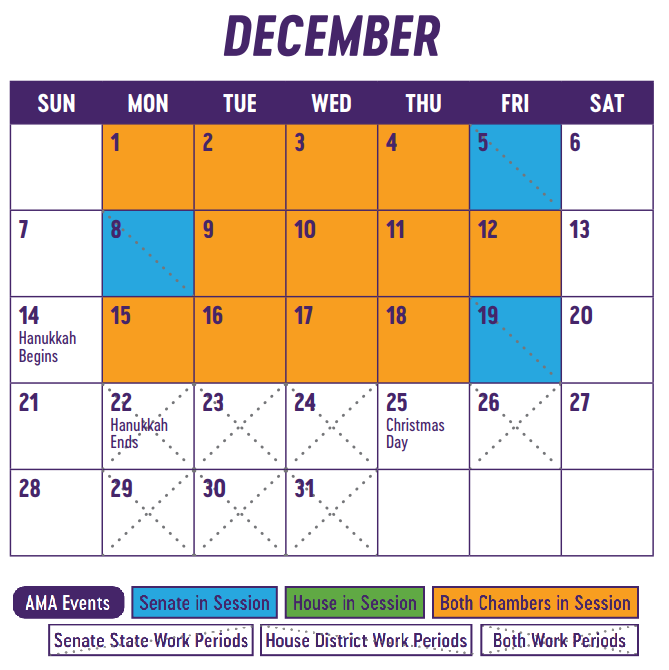
Welcome to the fall edition of the AMA's Very Influential Physician (VIP) Insider. Read on for details about these topics: -
New maps may not be enough to save the House GOP
- Senate rating change: Maine moves from "Leans Republican" to "Toss Up"
- Urge Congress to help stop new H-1B visa fees for physicians
-
Join the AMA for upcoming advocacy webinar on the One Big Beautiful Bill Act
|
New maps may not be enough to save the House GOP
By Charlie Cook at the National Journal
For months, President Trump and his White House have mounted a full-court press on Republican governors and GOP-controlled state legislatures in an effort to redraw as many congressional district boundaries as possible.
Democrats have pushed aside their own good-government principles to respond in kind in California, a move that looks likely to offset some of the seats that they can expect to lose next year.
On Friday, Air Force Two touched down in Indianapolis for a previously unannounced visit by Vice President J.D. Vance—his second in three months—to lobby reluctant GOP state legislators to redraw Indiana's lines. The move contributes to an air of Republican desperation. Clearly they see this as necessary in order to retain their majority in the House, which they currently hold at 219 to 213 with three vacancies. Once all members are elected and sworn in, the chamber will be back to 220-215, putting Democrats just three short of the barest possible majority.
The current Indiana boundaries have yielded a delegation split between seven Republicans and two Democrats. Republicans hope to make the tally eight to one; gaining two seats would require some unusually creative cartography.
Those of us who have watched elections and polling for a long time have had to reckon with a very different set of voting patterns in recent years. Before our current era of hyper-partisanship, it was possible for a president's approval ratings to soar to great heights and plunge to stomach-churning depths. President George H.W. Bush reached as high as 89 percent in the Gallup Poll after the victory in the first Persian Gulf War, but he sank down to 25 percent when economic troubles hit, a 64-point differential. His son went a point higher to 90 percent in the aftermath of 9/11, later dropping to 25 percent himself, a 65-point difference. President Reagan's peak was 68 percent, with a valley of 35 percent. President Obama's low was 38 percent, with a high of 69 percent; and President Clinton's low point was 37 percent, with a high of 73 percent.
But today things are different. No matter how bad things get, fellow partisans will not abandon their party's leader, and equally adamant voters of the opposite party will never support him, no matter what. This creates floors much higher than in the old days, but also ceilings much lower. Theoretically, that should make things less volatile.
Not so much. That slice of voters in the middle, while smaller than ever before, is maybe even more malleable than ever. This is especially true when a president or party misinterprets an election, thinking the voters were sending an enthusiastic vote in support of them and their agenda rather than lashing out against the previous incumbent.
It's this group that should give Republicans pause. Beneath the hood, one can see that President Trump's support comes almost entirely from his base. Beyond that, things get pretty ugly. In recent polls, we're seeing twice as many independents disapproving as approving of the job Trump is doing. Many of them thought they were simply casting a vote in 2024 to discontinue the Biden-Harris administration. For them, the last 267 days is not the cruise they signed up for.
Such shifts among independents—especially in key swing states—can have enormous consequences. Witness the seven purple states of Arizona, Georgia, Michigan, Nevada, North Carolina, Pennsylvania, and Wisconsin. Trump won six out of seven in 2016, all but Nevada. Joe Biden won six out of seven in 2020, all but North Carolina. All seven went into Trump's column in 2024. The House has never been so evenly divided as it has been for the last three elections.
Operationally what does this mean? With the ink not even on paper in some of these states' redistricting efforts, it is impossible to say with any degree of certainty how this will play out in the House. I am skeptical that Republicans can redraw enough districts to insulate them from what looks like a pretty tough midterm. |
Senate rating change: Maine moves from "Leans Republican" to "Toss Up"
By Kyle Kondik and J. Miles Coleman of Sabato's Crystal Ball
Recently, Maine Gov. Janet Mills (D) moved ahead with her long-anticipated entry into her state's Senate contest. With that, national Democrats were at least able to recruit their preferred candidates in the two states that represent Democrats' clearest-cut offensive opportunities on the 2026 Senate map: Maine and North Carolina. In the latter, former Gov. Roy Cooper (D) announced his campaign over the summer; we suspect he'll be locked in a close race with former Republican National Committee Chairman Michael Whatley, who is a heavy favorite for the GOP nod, right up until Election Day 2026. And now Mills is running in Maine, although she may still face a competitive primary (more on that below).
For Democrats' "Senate math," it is hard to overstate Maine's importance. Sen. Susan Collins (R) is the only Republican in the chamber who represents a state that voted against Donald Trump in all three of his general election campaigns.
We have been thinking about moving Maine from Leans Republican to Toss-up for months, and Mills's entry is enough for us to move ahead with that change. Our main reasons for moving the race are as follows:
1. As a Republican senator in a state that votes Democratic for president, Collins is a major outlier; indeed, while Democrats do hold a number of Senate seats in states that voted for Donald Trump, they have lost all of their senators in states that are more reliably Republican for president: Their losses in Montana, Ohio, and West Virginia last year represented the "end of the line" for red-state Senate Democrats. So Collins is really the only senator among the 100 who represents a state that not only reliably votes for the other party for president, but is not really even a true presidential battleground. Trump did get an electoral vote from Maine's 2nd Congressional District in all three of his elections, but the 1st District is bluer than the 2nd is red, which explains the state's overall blue lean.
2. Polls differ on Collins's approval/favorability rating, but the bulk of them point to her numbers being underwater. There was a Pan Atlantic Research poll from May that showed Collins's favorability as 49% favorable/45% unfavorable. A University of New Hampshire poll from April, by contrast, showed her favorability split as just 12% favorable/58% unfavorable, although another 27% selected "neutral." Back in July, Morning Consult's quarterly approval tracking of all senators showed her approval split at 38% approve/54% disapprove. A more recent poll from a Democratic pollster, Zenith Research (run by Adam Carlson, who we sometimes cite), showed Collins at a 40%/47% favorability split. Our bottom line here is one could "choose your own adventure" and tell different stories about Collins using these different polls, but the bulk of the public data point to an underwater approval/favorability.
3. The biggest question about this race was whether Collins would face a strong Democratic opponent or not. Mills, a two-term governor, does give Democrats a credentialed recruit. Previously, the Democratic field had a number of options but lacked someone who is electorally proven: Graham Platner (D), an oyster farmer, veteran, and first-time candidate, has generated a lot of attention since announcing his candidacy a couple of months ago; Jordan Wood, a former congressional staffer, has also gotten some buzz (though not nearly to the level of Platner). Another candidate, brewery owner Dan Kleban, dropped out Tuesday and endorsed Mills. As a sitting governor and proven candidate, Mills has to start the primary as a favorite. However, if Mills were to lose the nomination to Platner or one of the others, perhaps that person will have proven themselves to be a strong candidate over the course of that race. There is also the possibility that Collins, who has not officially announced her bid for another term but has been acting like a candidate, could decide to retire.
To sum it up, we view the race as a Toss-up now because Collins is an electoral outlier; Collins's approval/favorability numbers are not great; and the chances of the Democrats producing a strong challenger have gone up now that Mills has entered. The first two reasons have been present for months; the third one is what has changed, which tips us over into making this change now. Continue reading
|
Urge Congress to help stop new H-1B visa fees for physicians
Recently the administration issued a proclamation that would impose a $100,000 application fee for H-1B visas.
Contact your members of Congress today and urge them to work with the Department of Homeland Security to exempt physicians from this exorbitant application fee increase.
This exorbitant fee would have to be paid by the physician's employer, creating yet another roadblock for bringing highly trained physicians into our communities. It would also place a heavy financial strain on Federally Qualified Health Centers, Rural Health Clinics, and nonprofit hospitals - many of which are already struggling with severe doctor shortages and growing patient demand.
With the U.S. projected to face a shortage of 86,000 physicians by 2036, these fees will only make the problem worse - limiting patient access to care, especially in rural and underserved areas, and increasing the risk of physician burnout.
Please contact your members of Congress and ask them to urge the Department of Homeland Security to issue an exemption for physicians!
The health care workforce relies upon physicians from other countries to provide high-quality and accessible patient care.
If the H-1B visa payment fees stay in place, our country's most vulnerable patients will not be able to receive the high-quality care they rely on.
Lend your voice today and we can ensure that international medical graduates remain able to serve patients across the country. |
Join the AMA for upcoming advocacy webinar on the One Big Beautiful Bill Act
Significant changes to health care are on the horizon now that the One Big Beautiful Bill Act of 2025 (OBBBA) has been signed into law: Medicaid eligibility and financing, access to health insurance coverage through the Affordable Care Act marketplaces, federal support of medical student loans, Medicare physician payment and more.
What do physicians need to know and how can they help their patients navigate these changes?
Register now to join the AMA for this Advocacy Insights webinar on OBBBA implementation on Nov. 5 at 7:30 p.m. CT to learn what is being done to prepare for these changes in health care delivery. |
Be sure to follow all the AMA's Physician Grassroots Network social media accounts for all the latest news on physician advocacy and what you can do to make sure your voice is heard on Capitol Hill. |
|
|
25 Massachusetts Ave. NW | Suite 600 | Washington, DC 20001 Copyright © 2025, American Medical Association If you no longer wish to receive our emails, please unsubscribe |
|
|
|