Welcome to the winter edition of the AMA's Very Influential Physician (VIP) Insider. Read on for details about these topics: - National Advocacy Conference round-up: physicians press Congress for Medicare payment fix
- Initial Senate ratings: Republicans start as strong favorites to hold majority
- Historical trends should give rebuilding Dems a lift
- Authentic advocacy in a culture of disruption
|
National Advocacy Conference round-up: physicians press Congress for Medicare payment fix
As mid-March government-funding deadline looms, physicians rally on Capitol Hill to send a clear message: Fix Medicare now.
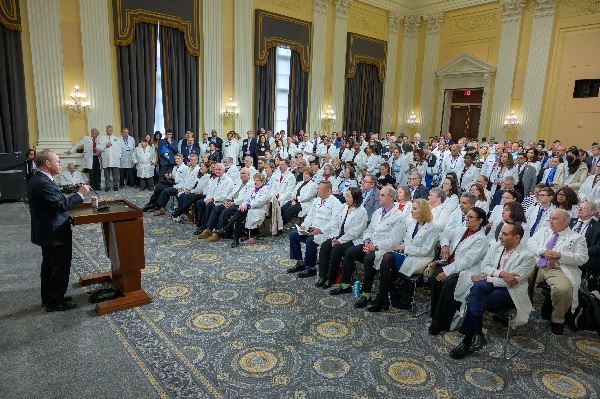
Hundreds of physicians in their white coats rallied in force in the oldest congressional office building in the nation's capital to show their support for the elected leaders who are advancing bipartisan legislation that would stop the 2.83% cut in Medicare payments to physician practices this year while providing a 2% payment update.
The AMA is leading the charge to reform the Medicare payment system and strongly supports the measure—H.R. 879, the Medicare Patient Access and Practice Stabilization Act. This legislation would, effective April 1, prospectively cancel the physician payment cut that took effect Jan. 1. The measure has already gathered 83 bipartisan co-sponsors.
Similar legislation introduced toward the end of the 118th Congress enjoyed bipartisan, bicameral support, but Congress failed to address the issue during the lame-duck session. The next legislative chance to reverse the cut comes in mid-March, which is the deadline to fund the federal government through the end of this fiscal year.
H.R. 879 was introduced by Reps. Greg Murphy, MD (R-N.C.), and Jimmy Panetta (D-Calif.), along with eight other bipartisan House members. Dr. Murphy and Panetta addressed the physician crowd in the Cannon House Office Building Tuesday and thanked them for coming to Capitol Hill to show Congress how the fifth straight year of physician payment cuts in Medicare is affecting patients' access to care and endangering physician practices.
Reps. Kimberly Schrier, MD (D-Wash.), Mariannette Miller-Meeks, MD (R-Iowa), John Joyce, MD (R-Pa.), Raul Ruiz, MD (D-Calif.), Ami Bera, MD (D-Calif.), and Mike Kennedy, MD (R-Utah), also spoke at the event. Several of the House members emphasized that they would be unable to vote "yes" on a government-funding deal if it failed to address the Medicare physician payment cut, with one dubbing it a "line in the sand."
The AMA also took out a full-page ad in Tuesday's edition of The Hill, which said "The Medicare Patient and Access and Practice Stabilization Act must be included in the next spending package" and included a QR code to learn more.
The show of force in Congress extended to more than 350 visits with House members and senators from physicians amid a storm that would dump over six inches of snow on Washington. The doctors making visits got top-notch training and resources at the AMA National Advocacy Conference, which ran February 10 -12.
|
Rep. Greg Murphy, MD (R-N.C.), addresses the crowd at the AMA’s Fix Medicare Now briefing in the Cannon House Office Building.
Training sessions at the conference counseled physicians on an effective "hook, line and sinker" approach to legislative meetings. The ultimate hook is the doctors' personal stories that show the impact of the Medicare payment cuts and the ask from every physician and medical student visiting with legislators was clear: House members should co-sponsor H.R. 879 and senators should introduce companion legislation in the Congress' upper chamber. An AMA action kit (PDF) gave doctors easy access to compelling facts and figures to bolster their personal stories.
The most astounding of these statistics is that—when adjusted for inflation in practice costs—physicians in 2025 are being paid 33% less (PDF) for care to Medicare patients than doctors were paid in 2001, according to AMA research.
Patients and physicians across the country can take similar action using Fix Medicare Now to ask their representatives to co-sponsor the Medicare Patient Access and Practice Stabilization Act today.
Continue reading |
Initial Senate ratings: Republicans start as strong favorites to hold majority
By Kyle Kondik and J. Miles Coleman from Sabato's Crystal Ball
While Republicans, who will be defending 22 of the 35 Senate seats up in 2026, may have the political environment working against them next year, they are still favored to retain the chamber.
Part of the reason for this is that Democrats hold two of our three initial Toss-up races, Georgia and Michigan, while GOP-held North Carolina will likely see another hotly-contested Senate race.
We are giving Maine's Susan Collins (R) a degree of deference by starting her race as Leans Republican, although as the only Republican representing a Kamala Harris-won state, it is hard to see Democrats getting close to a majority without her seat.
If Democrats were to be on track to regain the Senate by the end of the decade, they would almost certainly have to come out of the 2026 cycle with a net gain of seats.
Rating the 2026 Senate map
The last two midterm elections help illustrate why even though the presidential party often draws the ire of the electorate in midterm elections, the trend of seat loss is much clearer in the House than in the Senate.
In both 2018 and 2022, the president's party lost the majority in the House of Representatives. While Democrats seemed to overperform expectations in the House in 2018 and Republicans seemed to underperform in 2022, the basic result of those elections was the same—voters put a check on the president by taking the House majority away from his party.
But in the Senate, the story was different. In each of those years, the president's party netted seats. Republicans came out of 2018 with 53 seats after they had won 52 in 2016, and Democrats came out of 2022 with 51 seats after they had won 50 in 2020.
A basic, Politics 101 explanation for the differences in outcomes in each of those years is simply that all 435 House seats are elected every two years, while only a third of the Senate is up every two years. So the makeup of the Senate map matters greatly in determining the outcome.
In 2018, Democrats were defending the lion's share of the seats contested, including in several states that are deeply Republican at the presidential level. Republicans flipped a number of these seats in that election, and then finished the job six years later, in 2024 (we looked at the partisan realignment of the Senate following the election). Meanwhile, in 2022, Republicans were defending more seats than Democrats, and a combination of factors allowed Democrats to defend all of their vulnerable seats while flipping an open seat in battleground Pennsylvania.
Continue reading |
Historical trends should give rebuilding Dems a lift
By Charlie Cook of the National Journal
History gives them about a 90 percent chance of retaking the House.
Given how bad midterm elections tend to be for the party holding the White House, it would be understandable if members of Congress and other candidates were to wish their team had lost in the previous presidential election. While Republican senators can feel pretty good about their majority, House Republicans should be steeling themselves for a loss next year. It’s not just about historical trends, but it is also the situation specific to 2026.
Exceptions do occur, but they tend to happen more often in the Senate, which has a much smaller and less representative sample of seats up every two years. The president’s party typically loses Senate seats in two out of three elections. In the House, however, which is a more sensitive barometer of the public mood, it’s more like nine out of 10.
The last midterm election saw one of those exceptions, when Democrats actually scored a net gain of a seat in the Senate and Republicans underperformed in the House, gaining only nine seats when it’s often at least double that in midterms. But while 2022 was something of an exception, it was not a random outcome. Republican primary voters in about two dozen races around the country nominated “exotic and highly problematic” candidates, my more tasteful term for weird and terribly flawed candidates in a handful of critical U.S. Senate, gubernatorial, attorney-general, and secretary-of-state contests around the country, as well as about 10 congressional races. These nutty nominees in about 30 decisive contests made all of the difference in the world, preventing the GOP from scoring the kind of victory one might expect when the opposition party had a sitting president with just a 40 percent approval rating in the Gallup poll.
This would seem to be an important lesson for Democrats next year: If they nominate candidates who can win over pure independent and swing voters, they will have a good chance of having a good election. Conversely, if in purple states and districts they nominate candidates who mirror the party’s base, the outcome might be a bit different.
For Democrats, 2025 and 2026 need to be rebuilding years. Two governorships are up for reelection this year, followed by a whopping 36 in 2026. At least 16 of those offices will be open due to term limits. Each party has one term-limited governorship up this year: Democrats in Kentucky, and Republicans in Virginia. In 2026, Democrats will try to hold onto open gubernatorial posts in six states: California, Colorado, Kansas, Maine, Michigan, and New Mexico; Republicans will be striving to hang onto Alabama, Alaska, Florida, Georgia, Ohio, South Carolina, Tennessee, and Wyoming.
One second-order effect of having so many open governorships is that it attracts House members and increasingly, senators, who may be willing to abandon their current jobs in a stalemated Washington in exchange for a shot at really running things as a governor back home. The Senate part is relatively new. In the 1990s, California’s Pete Wilson started a trend of senators opting for gubernatorial runs instead of the other way around. So watch for how many open House and even Senate races pop up out of frustration with how things in Washington are, or aren’t, going.
The first Gallup poll of Trump Part Deux was released last week, indicating that 47 percent of Americans approved the job he was doing so far, 2 points higher than in his first poll in 2017. Forty-eight percent disapproved, 3 points more than two years ago (there are fewer undecideds this year). Not surprisingly, 91 percent of Republicans approved (5 percent disapproved), independents split almost evenly, 46-48, and just 6 percent of Democrats approved against 92 percent who disapproved. In his first term, Trump’s approval rating had a very narrow trading range—never exceeding 49 percent nor dropping below 34 percent, a much narrower spread than for any previous president. It’s a decent bet he’ll stay roughly in that range this term as well.
It will be tempting for Trump critics to say that following the actions he took after Gallup was in the field from Jan. 21-27, his approval rating will likely drop. That could happen, but we should remind ourselves of how seemingly impervious his numbers have been to news. Basically one-third of voters will love him no matter what, and roughly half, maybe a hair under, will hate him no matter what.
What is clear is that Trump does best when he has a foil, a devil to beat on. He did well against Hillary Clinton in 2016 and inferentially against then-President Biden in 2024, but in the 2018 midterms and the 2020 presidential election, not as well.
Clearly, Trump is trying out a number of possible targets, domestic and foreign. We’ll see who he settles on and who puts up with it or strikes back. |
Authentic advocacy in a culture of disruption
By Jen Daulby, CEO of The Congressional Management Foundation
Every new administration, in its own way, brings about change. However, the new administration, elected in part on the promise of disrupting the status quo, is moving swiftly to make sweeping and consequential changes to federal agencies and programs. These changes—whether through restructuring, cuts, or complete overhauls—have left stakeholders in a kind of paralysis, uncertain about how best to respond and advocate for their priorities.
For a long time, whether through grassroots campaigns, grasstops advocacy, or astroturf efforts, advocates for specific federal programs and agencies have primarily targeted a narrow group of decision-makers in Washington. However, insufficient attention has been paid to engaging the broader public, who are often unaware of the impact of these programs on their daily lives and communities.
Furthermore, the incentives of our current political environment have encouraged the last several Administrations to bypass or ignore Congressional oversight, consolidating policymaking and fiscal policy through executive actions. At the same time, a few vocal members of Congress seem focused on social media trends and media appearances, rather than upholding the checks and balances essential to effective governance.
Stakeholders and advocates must acknowledge that voters inherently harbor skepticism toward federal programs and agencies. This skepticism, compounded by a lack of information about how specific programs impact individuals or communities, makes the electorate susceptible to oversimplified talking points and misleading narratives. As a result, advocates are caught flat-footed in a fast-moving, disruptive policy environment, where understanding and engagement are more critical than ever.
Continue reading |
Be sure to follow all the AMA's Physician Grassroots Network social media accounts for all the latest news on physician advocacy and what you can do to make sure your voice is heard on Capitol Hill. |
|
|
25 Massachusetts Ave. NW | Suite 600 | Washington, DC 20001 Copyright © 2025, American Medical Association If you no longer wish to receive our emails, please unsubscribe |
|
|
|